
 Spanish
What causes wattage differences among E14 LED amusement lights?
The wattage differences among E14 LED amusement lights stem primarily from variations in LED chip count, chip type, and the physical size of the bulb base, which together determine how much power a bulb can draw and how bright it can be.
LED Chip Count and Type
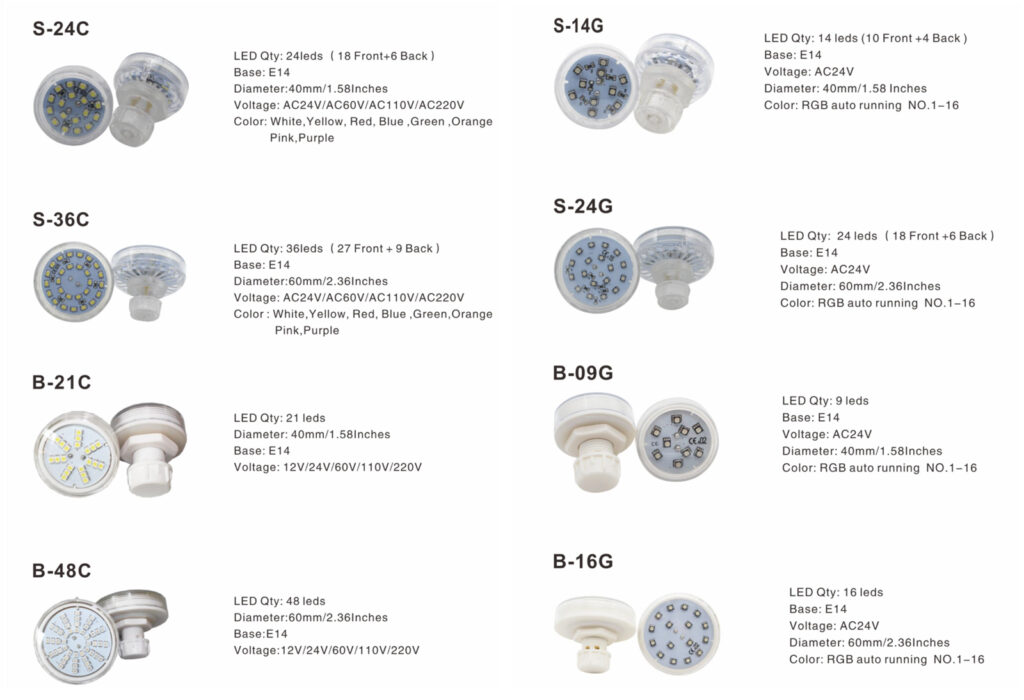
The most direct cause of wattage variation is the number and type of LED chips inside the bulb. For example, Fun Amusement Lighting‘s 14-LED SMD2835 model draws 1–2W, while their 21-LED SMD2835 models draw 1.5–2.5W. Similarly, bulbs using 3528 or 1210 chip types show different power draws even with comparable LED counts, ranging from 0.5W to 1.5W depending on the configuration. More chips generally mean higher wattage and greater light output.
Base Size and Power Capacity
The E14 base itself is a key factor. E14 bulbs have a 14mm screw base, which is larger than the E10 base (10mm). This larger base allows E14 bulbs to support higher wattages, making them suitable for installations requiring more light. E10 bulbs, by contrast, typically have lower power and brightness due to their smaller size. Within the E14 category, manufacturers can push wattage higher because the base and housing can accommodate more or larger LED chips and better heat dissipation.
Manufacturer Design Choices
Different manufacturers make different trade-offs between brightness, energy efficiency, and cost. Some prioritize low-wattage, energy-saving designs, while others offer higher-wattage bulbs for brighter output. For instance, a standard E14 LED bulb for home use typically consumes 3–8W, but amusement-specific E14 LEDs are designed to be much lower power—often 1W to 3W—because they run on low-voltage systems (24V, 60V, 120V) and are used in large numbers across rides. This is a deliberate design choice for the amusement industry, where hundreds of bulbs may be wired to a single transformer.
Voltage and Application
The input voltage also influences wattage. Amusement E14 bulbs are available in AC 24V, 60V, 120V, and 240V versions. While voltage itself doesn’t directly determine wattage, the bulb’s internal driver and LED configuration are designed for a specific voltage, and this affects the overall power draw. For example, a 1.2W module rated for AC 24V/60V/120V/240V will draw the same wattage across those voltages, but the driver circuitry differs
Summary
In short, wattage differences among E14 LED amusement lights are caused by:
- LED chip count and type (more or larger chips = higher wattage)
- Base size (E14 supports higher wattage than E10)
- Manufacturer design priorities (energy efficiency vs. brightness)
- Voltage and driver design for the specific application
When selecting bulbs, always check the specific wattage rating on the product, as it varies by model and manufacturer.