
 Spanish
Ferris Wheel LED Lighting Guide
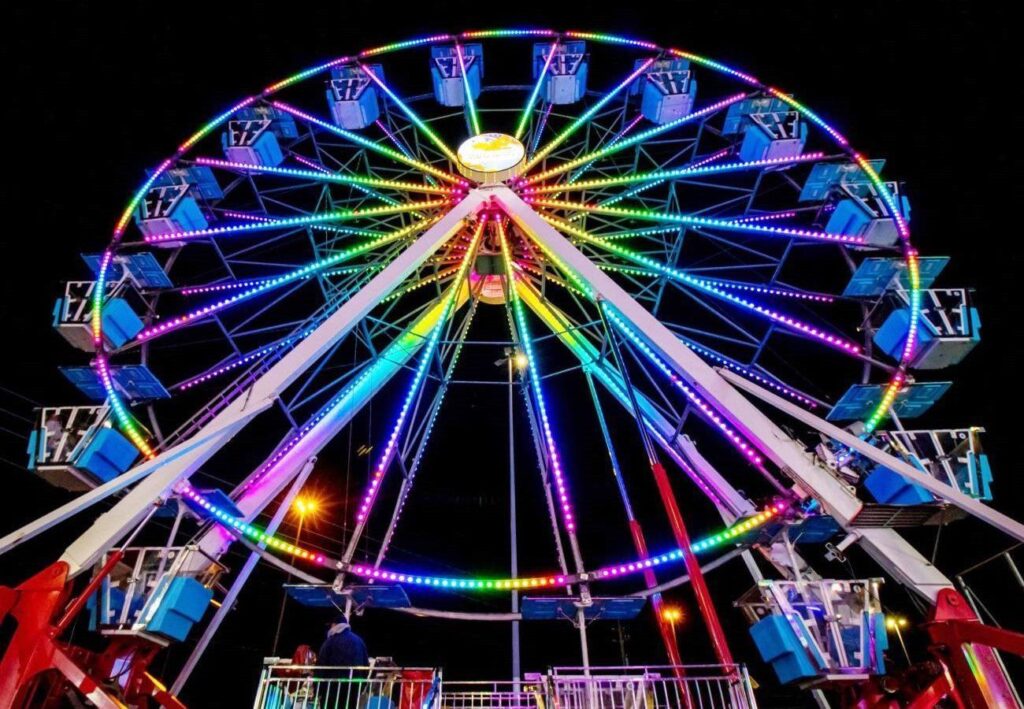
A well-designed Ferris wheel LED lighting system can transform a ride into a highly visible landmark, attract visitors from a distance, and create dynamic nighttime displays. However, choosing the right lighting requires more than simply selecting bright LED lamps.
This guide explains the main types of Ferris wheel lighting, key specifications, control options, installation considerations, and how to choose the right system for your project.
1. What Is Ferris Wheel LED Lighting?
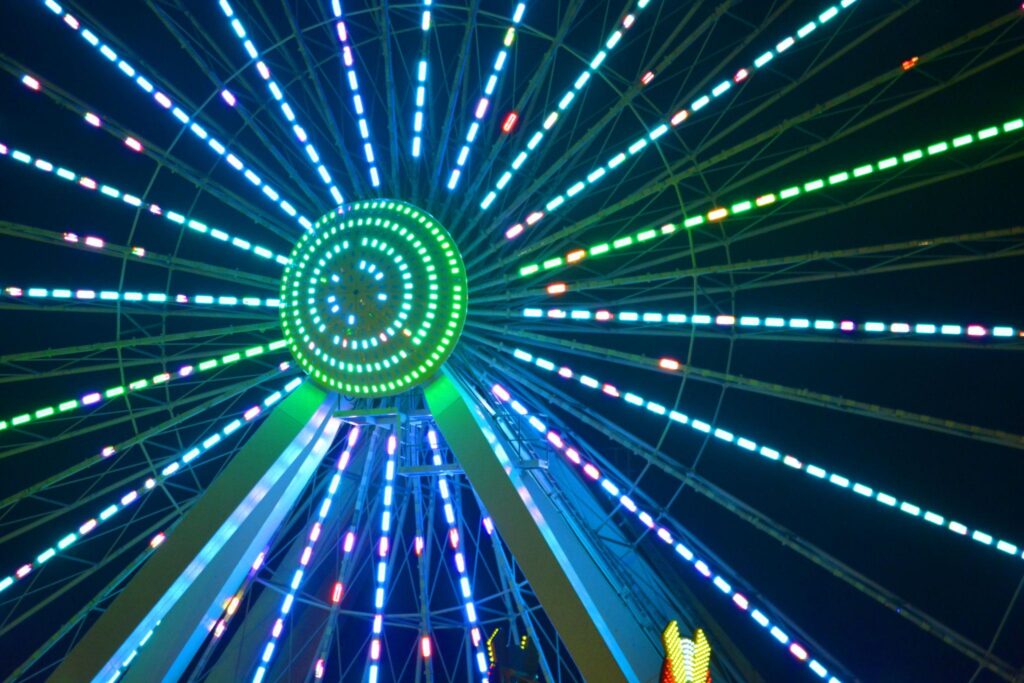
Ferris wheel LED lighting refers to LED fixtures installed on the rim, spokes, cabins, center structure, or other decorative parts of a Ferris wheel.
Depending on the design, the lighting can provide:
- Static illumination — one fixed color
- Color-changing effects — multiple RGB colors
- Chasing and animation effects — moving patterns around the wheel
- Pixel effects — individual LEDs or sections controlled independently
- Synchronized shows — lighting coordinated with music, events, or other attractions
For amusement parks, carnivals, fairs, and family entertainment centers, LED lighting is increasingly used as both decoration and visual branding.
2. Main Types of Ferris Wheel LED Lights
Single-Color LED Lights
Single-color lights produce one fixed color, such as:
- Red
- Green
- Blue
- White
- Yellow
- Amber
They are a practical choice when the Ferris wheel has a simple decorative design or needs consistent illumination.
Advantages:
- Simple control
- Lower system complexity
- Easy installation
- Suitable for traditional carnival designs
- Good for large-scale static decoration
RGB LED Lights
RGB lights combine red, green, and blue LEDs to produce a wide range of colors.
They are suitable when the operator wants the Ferris wheel to change colors throughout the evening.
Typical effects include:
- Color fading
- Flashing
- Alternating colors
- Rainbow effects
- Rotating color patterns
RGB is often a good choice for Ferris wheels that need more visual variety without requiring individual pixel control.
Programmable LED Lights
Programmable lighting allows operators to create customized sequences and animations.
For example:
Red → Blue → Green → White → Color Chase → Fade → Repeat
The lighting program can be configured according to the wheel’s structure and the desired visual effect.
This is particularly useful for:
- Seasonal events
- Festivals
- Special promotions
- Holiday displays
- Opening ceremonies
Pixel LED Lights
Pixel lighting provides a higher level of control because individual LEDs or defined pixel groups can be controlled separately.
This makes it possible to create:
- Moving graphics
- Rotating patterns
- Text effects
- Logos
- Wave effects
- Spiral animations
- Complex geometric patterns
For a large Ferris wheel intended to function as a visual centerpiece, pixel lighting can provide significantly more creative possibilities.
3. Where Should LED Lights Be Installed?
The installation position has a major effect on the final appearance.
Wheel Rim
Installing LEDs around the outer rim emphasizes the circular shape.
It can create effects such as:
● → ● → ● → ● → ●
or a continuous rotating light effect.
Spokes
LEDs installed along the spokes can create radial patterns.
For example:
       ●
       │
   ●───●───●
       │
       ●
When programmed correctly, the spokes can appear to rotate or pulse.
Center / Hub
Lighting around the central hub can provide a focal point and help integrate the center of the wheel with the outer lighting.
Passenger Cabins
Small LED fixtures can also be used around passenger cabins or decorative components.
This can create a more integrated appearance, but installation must account for:
- Weight
- Wiring
- Mechanical movement
- Maintenance
- Passenger safety
4. Important Specifications to Consider
When purchasing Ferris wheel LED lighting, don’t focus only on wattage.
A professional buyer should evaluate the following specifications.
| Specification | Why It Matters |
|---|---|
| LED Type | Determines brightness and color performance |
| Voltage | Must match the power system |
| Power Consumption | Affects operating costs and power supply sizing |
| IP Rating | Important for outdoor weather protection |
| Beam Angle | Determines light coverage |
| Color | Determines the visual appearance |
| Control Protocol | Determines animation and synchronization capabilities |
| Housing Material | Affects durability |
| Operating Temperature | Important for outdoor applications |
| Lifespan | Affects maintenance requirements |
| Connector Type | Influences installation efficiency |
| Cable Length | Important for large Ferris wheels |
For outdoor amusement equipment, weather resistance and mechanical reliability are particularly important.
5. IP Rating for Outdoor Ferris Wheels
Ferris wheels are normally exposed to rain, dust, humidity, and temperature changes.
Therefore, the LED housing should provide appropriate protection against environmental conditions.
For example, IP65 generally indicates protection against dust and water jets, while higher IP ratings can provide additional protection depending on the product design.
However, buyers should not select a product based on the IP rating alone. The complete system should also be evaluated, including:
- Connectors
- Cables
- Power supplies
- Controllers
- Junction boxes
- Installation methods
A high IP rating on the lamp does not automatically make the entire lighting system waterproof.
6. Lighting Control System
The controller is one of the most important components of a dynamic Ferris wheel lighting system.
A basic system may look like:
LED Lights → Controller → Power Supply → Control Software
More advanced systems may include:
LED Pixel Lights → DMX Controller → Lighting Software → Show Program
Depending on the project, the system can support:
- Static colors
- Automatic programs
- Speed adjustment
- Brightness adjustment
- Color selection
- Animation sequences
- DMX control
- Synchronized lighting
For a large Ferris wheel, it is important to plan the control zones before installation.
7. How to Choose the Right Ferris Wheel LED Lighting
A useful way to select a lighting system is to start with the desired visual effect.
Choose Single Color if:
- You want simple illumination
- The design uses one primary color
- Cost and simplicity are priorities
- Complex animation is not required
Choose RGB if:
- You want multiple colors
- You want automatic color-changing effects
- You need flexible decorative lighting
- You don’t need individual pixel animation
Choose Programmable if:
- You need customized lighting sequences
- The Ferris wheel is used for events
- You want different programs for different occasions
Choose Pixel LED if:
- You want advanced animation
- You need individual sections to be controlled independently
- You want logos, graphics, or text
- The Ferris wheel is intended to be a major nighttime attraction
8. Installation Considerations
Ferris wheel lighting is different from ordinary architectural lighting because the structure is constantly moving.
Before installation, consider:
Mechanical Movement
Cables and fixtures must accommodate the movement of the wheel without excessive stress.
Weight
Lighting equipment should be lightweight enough to avoid unnecessarily increasing the mechanical load.
Cable Management
Cables should be securely routed and protected from:
- Friction
- Sharp edges
- Repeated movement
- Water exposure
- Mechanical interference
Maintenance
LED fixtures should be positioned so that technicians can replace or service them efficiently.
For large amusement projects, modular LED fixtures and connectors can significantly simplify maintenance.
9. Common Ferris Wheel Lighting Problems
Uneven Brightness
Different LED fixtures may produce inconsistent brightness if the LEDs, optics, or power distribution are not properly matched.
Color Inconsistency
RGB systems can show noticeable color differences when LEDs or controllers are not properly calibrated.
Voltage Drop
Large Ferris wheels may require long cable runs. Voltage drop can result in LEDs becoming dimmer toward the end of a circuit.
A professional system should therefore consider:
Power Supply Capacity + Cable Length + Voltage Drop + Load Distribution
Poor Synchronization
If different sections of the wheel are not correctly synchronized, animations can appear discontinuous.
Insufficient Weather Protection
Outdoor amusement equipment needs protection against rain and environmental exposure throughout its operating life.
10. Ferris Wheel LED Lighting Buying Checklist
Before placing an order, ask the supplier:
- What LED type is used?
- What is the operating voltage?
- What is the power consumption per lamp?
- What is the IP rating?
- What colors are available?
- Is RGB available?
- Can the lights be individually controlled?
- What controller or protocol is supported?
- Are custom programs available?
- How are the lights connected?
- What cable and connector options are available?
- Can OEM colors and housing designs be provided?
- What certifications are available?
- What is the warranty?
- Are replacement parts available?
11. Final Selection Guide
| Requirement | Recommended Lighting |
|---|---|
| Simple decorative lighting | Single Color LED |
| Multiple colors | RGB LED |
| Custom lighting sequences | Programmable LED |
| Advanced animation | Pixel LED |
| Large Ferris wheel landmark | Programmable / Pixel LED |
| Event and festival lighting | RGB / Programmable LED |
| Lowest system complexity | Single Color LED |
The key is to design the lighting system around the Ferris wheel—not simply select the brightest lamp.
For amusement ride applications, the ideal solution should balance brightness, color effects, control capability, weather resistance, installation, maintenance, power consumption, and overall project cost.
If you’re sourcing lights for a Ferris wheel project, the most important step is to provide the supplier with the wheel diameter, number of spokes, desired installation positions, LED quantity, voltage, and required lighting effects. This allows the supplier to recommend the appropriate LED fixture, controller, power supply, and wiring configuration.