
 Spanish
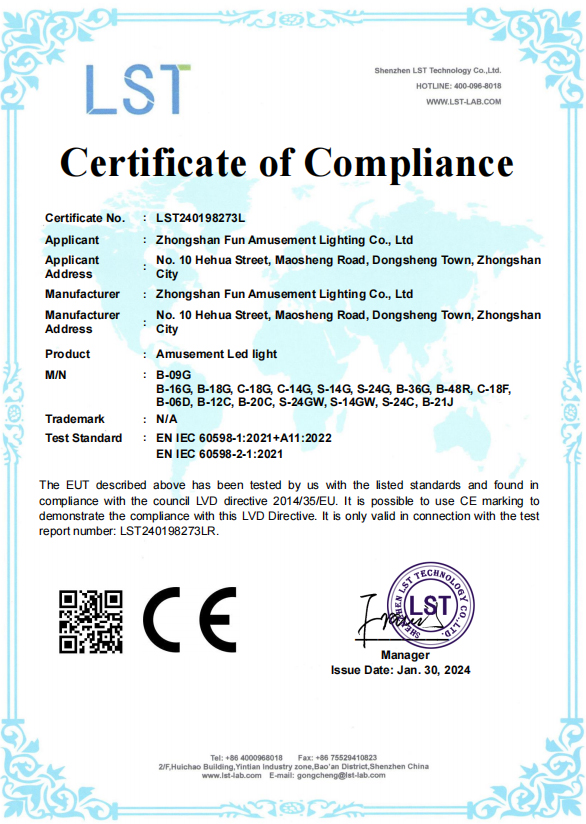
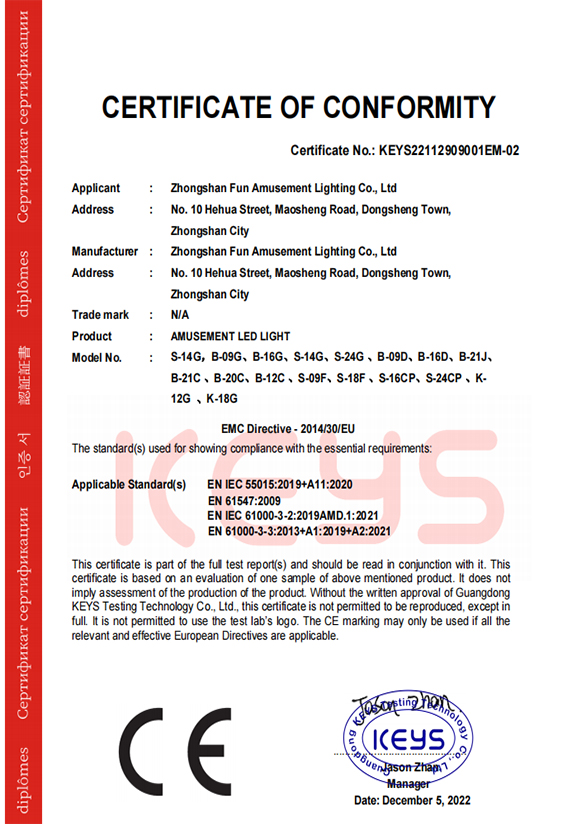
How do CE and RoHS standards affect amusement ride lighting products?
CE and RoHS standards fundamentally shape how amusement ride lighting products are designed, manufactured, and sold, particularly in the European market. These regulations act as both a market access requirement and a driver of product innovation.
CE Marking: The Market Access Requirement
The CE marking is the manufacturer’s declaration that a product meets all applicable EU rules necessary for sale in the European Economic Area (EEA). It is not a product standard itself, but rather a market access requirement. For amusement ride lighting products, which are electrical and electronic equipment, CE marking is mandatory before they can be legally sold in the EU.
The CE marking process involves several steps: identifying all applicable directives, determining whether self-assessment or a notified body is required, preparing and signing a Declaration of Conformity, and compiling a full Technical File available for authorities upon request.
RoHS: Restricting Hazardous Substances
RoHS (Restriction of Hazardous Substances) mandates the restriction of hazardous substances in electrical and electronic equipment. For amusement ride lighting, this means products cannot contain prohibited levels of substances such as lead, mercury, and cadmium. RoHS compliance has become a core part of product quality, improving reliability and reducing risk.
The direct link between RoHS and CE is critical: electrical and electronic equipment must meet RoHS substance restrictions before it can be CE-marked. Non-compliant products cannot be CE marked and sold in the European Union or to customers who otherwise require the CE mark. This means RoHS compliance is effectively a prerequisite for CE certification for amusement ride lighting products.
Impact on Product Design and Manufacturing
RoHS regulations compel manufacturers to change how they design electronic products, prohibiting the use of certain dangerous chemicals like lead, mercury, or cadmium and requiring the selection of safer materials. This has several practical effects on amusement ride lighting:
- Material substitution: Manufacturers must find alternatives to restricted substances in solder, wiring, and components.
- Cleaner production processes: RoHS compliance compels manufacturers to engage in cleaner production processes.
- Quality management systems: For RoHS compliance, quality management systems must be designed to avoid introducing prohibited compounds into goods during manufacturing.
Global Variations
While the EU RoHS is the most well-known, other markets have their own versions. China RoHS, for example, only affects products and components listed in the promulgated catalog of electronic information products, which differs from the EU’s broader scope. The new Chinese RoHS national standard (GB 26572-2025) has been implemented, and emerging markets are introducing similar regulations, increasing supply chain compliance risks. For amusement ride lighting manufacturers, this means navigating a complex landscape of varying requirements across different markets.