
 Spanish
The Complete Guide to Amusement Ride Lighting
Amusement ride lighting is more than decoration. The right lighting system can enhance the visual appeal of a ride, strengthen its identity, improve nighttime visibility, and create a more memorable experience for visitors.
From classic carousel bulbs to RGB, programmable, and pixel LED systems, there are many options available. This guide explains the major types of amusement ride lighting, how to choose them, and what buyers should consider before placing an order.
1. What Is Amusement Ride Lighting?
Amusement ride lighting refers to LED lamps, bulbs, strips, flood lights, pixel lights, and related control systems used to decorate and illuminate amusement rides and equipment.
Typical applications include:
- Carousels
- Ferris wheels
- Kiddie rides
- Bumper cars
- Roller coasters
- Spinning rides
- Family rides
- Fairground attractions
- Carnival equipment
- Amusement park decorations
Lighting can be installed along ride outlines, structural frames, platforms, canopies, cabins, columns, signs, and other decorative areas.
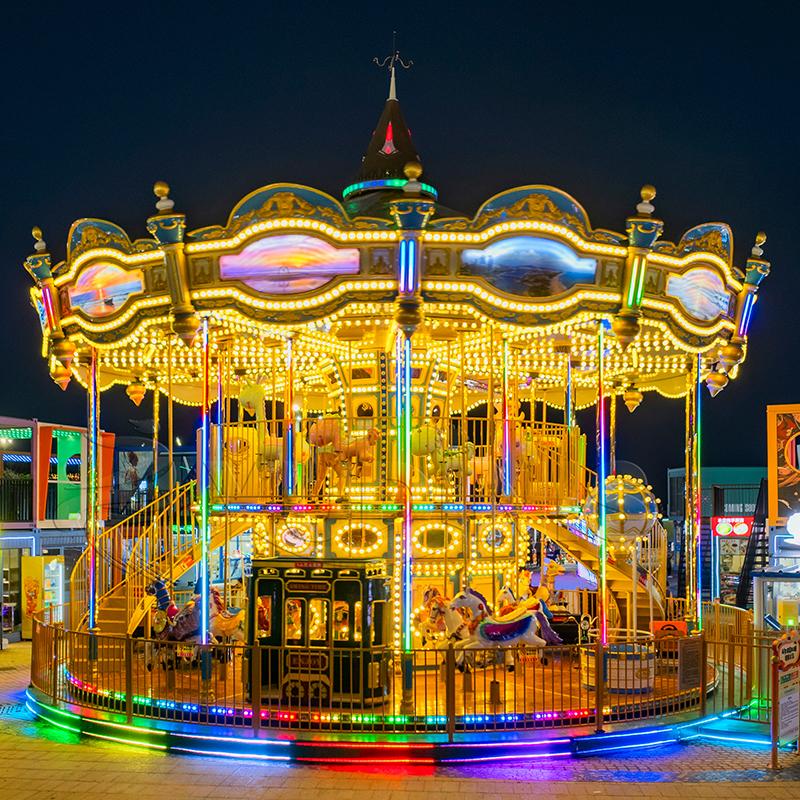
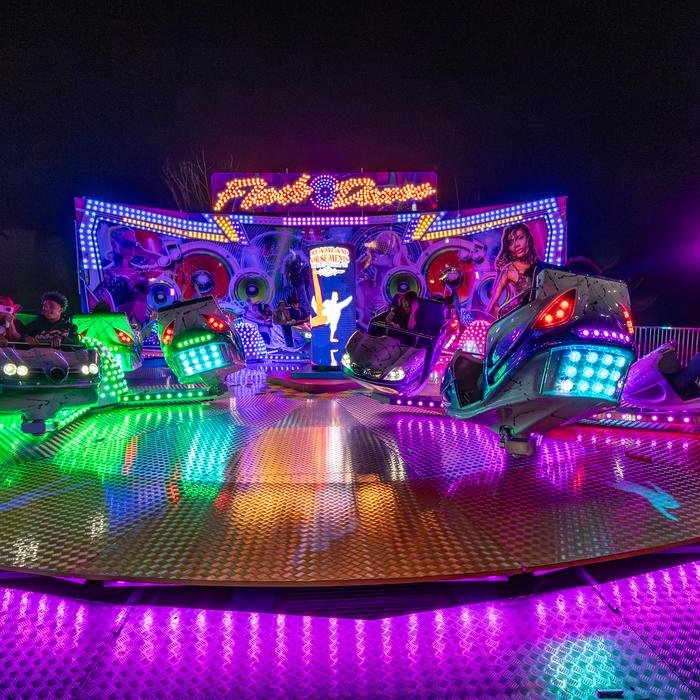
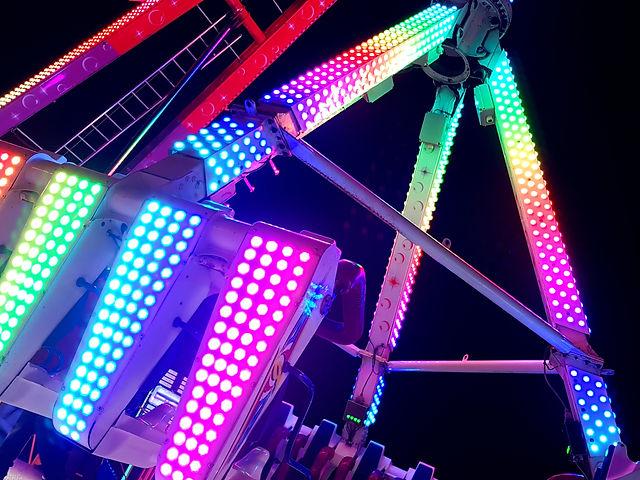
2. Why Is Lighting Important for Amusement Rides?
A well-designed lighting system can serve several purposes.
Visual attraction
Bright and dynamic lighting helps an amusement ride stand out, particularly in the evening.
Ride identification
A consistent color scheme and lighting pattern can help create a recognizable visual identity for a ride or amusement park.
Decorative enhancement
Lighting highlights the shape and architectural features of amusement equipment.
Dynamic entertainment
Programmable and pixel lighting can introduce movement, color changes, and animated effects.
Nighttime visibility
Appropriately designed lighting can make ride structures and surrounding areas more visible after dark.
Lighting should therefore be considered as part of the ride’s overall design rather than simply an accessory added at the end of a project.
3. Main Types of Amusement Ride LED Lights
There is no single lighting solution for every amusement ride. The most common options can be divided into four categories.
Single Color LED Lights
Single-color lights produce one fixed color, such as:
- Red
- Yellow
- Blue
- Green
- White
- Warm white
They are suitable for classic amusement rides and projects where simplicity and cost efficiency are important.
Advantages:
- Simple system design
- Easy installation
- Easy maintenance
- Lower system cost
- Suitable for large quantities
Best for: traditional carousels, kiddie rides, ride outlines, and basic decorative lighting.
RGB LED Lights
RGB lights use red, green, and blue LEDs to produce multiple colors.
Compared with single-color lighting, RGB provides considerably more flexibility for changing the appearance of a ride.
Advantages:
- Multiple colors
- Color-changing effects
- More flexible visual design
- Suitable for modern amusement equipment
Best for: modern rides, themed attractions, and projects requiring multiple color effects.
Programmable LED Lights
Programmable amusement lights allow users to create lighting sequences and effects.
Typical effects include:
- Chasing
- Flashing
- Fading
- Running lights
- Alternating patterns
- Color transitions
These systems are particularly useful when the objective is to make the lighting itself part of the attraction.
Best for: high-visibility rides, carnival attractions, and amusement equipment requiring dynamic effects.
Pixel LED Lights
Pixel LED systems provide more advanced control, often allowing individual pixels or groups of pixels to be controlled independently.
This enables more complex effects and animations.
Best for: large-scale amusement attractions, flagship rides, entertainment venues, and projects requiring sophisticated animated lighting.
The trade-off is that pixel systems generally require more sophisticated controllers, programming, wiring, and installation.
4. LED Bulbs vs LED Strips vs Flood Lights
Choosing the lighting technology is only part of the decision. The physical form of the light is also important.
| Lighting Type | Typical Application | Main Advantage |
|---|---|---|
| LED Bulb/Lamp | Ride outlines, carousel, decorative structures | Classic appearance |
| LED Strip | Curves, edges, continuous lines | Flexible installation |
| LED Pixel | Animated patterns and effects | Individual control |
| LED Flood Light | Large surfaces and structures | High-area illumination |
| LED Sign/Screen | Ride branding and information | Visual communication |
For example, a Ferris wheel might combine LED lamps on the wheel structure with programmable or pixel lighting, while a carousel might use decorative LED bulbs around the roof and columns.
5. How to Choose the Right Amusement Ride Lighting
Before purchasing, buyers should evaluate several factors.
5.1 Ride Type
Start with the equipment.
A carousel, Ferris wheel, bumper car, and roller coaster have very different structures and lighting requirements.
Consider:
- Installation surface
- Available space
- Ride movement
- Curved or straight structures
- Number of lighting points
- Cable routing
5.2 Desired Lighting Effect
Ask what the finished ride should look like.
Classic appearance:
Choose single-color lamps.
Multiple colors:
Consider RGB.
Moving lighting effects:
Choose programmable lighting.
Advanced animation:
Consider pixel LED technology.
5.3 Voltage
Voltage compatibility is critical.
The lighting system must match the ride’s electrical infrastructure or use an appropriate power supply.
Before ordering, confirm:
- Input voltage
- Operating voltage
- Power supply requirements
- Total system load
- Controller compatibility
Never select a product based only on appearance or unit price.
5.4 Outdoor Protection
Most amusement rides operate outdoors, making environmental protection important.
Depending on the installation environment, buyers should evaluate:
- Water resistance
- Dust protection
- UV exposure
- Temperature range
- Connector protection
- Cable quality
- Housing material
An appropriate IP rating should be selected according to the actual installation environment rather than simply choosing the highest number available.
5.5 Brightness
A lamp that looks bright indoors may not be sufficient outdoors at night.
However, maximum brightness is not always the goal. Excessive brightness can create unnecessary energy consumption and may negatively affect the overall visual design.
The lighting system should provide sufficient illumination while maintaining a balanced appearance.
6. Controller and Programming
For dynamic lighting systems, the controller is just as important as the LED lamp.
A complete system may include:
LED lights → cables/connectors → power supply → controller → programming/software
Before purchasing, confirm that the lamps and controller are compatible.
For programmable and pixel systems, buyers should ask suppliers:
- What controller is required?
- How many lights can one controller operate?
- Can multiple controllers be synchronized?
- Are lighting programs customizable?
- Can programs be changed after installation?
- Is special software required?
- Can the system be synchronized with other ride lighting?
These questions can prevent compatibility problems during installation.
7. Installation Considerations
Amusement rides have moving structures, vibration, weather exposure, and frequent operating cycles.
Therefore, installation requires more attention than ordinary architectural lighting.
Pay particular attention to:
Cable routing
Cables should be properly secured and protected from mechanical movement.
Connectors
Outdoor connectors should be suitable for the environment and securely installed.
Mechanical stability
Lights should remain securely attached during ride operation and vibration.
Maintenance access
Products should be positioned so that failed lamps can be replaced efficiently.
Spare parts
For large installations, keeping an appropriate quantity of spare lamps, connectors, and other components can reduce downtime.
8. Energy Efficiency and Operating Cost
For large amusement rides, hundreds or even thousands of lighting points may be installed.
Consequently, power consumption can become an important operating cost.
When comparing products, calculate:
Total Power Consumption = Number of Lights × Power per Light
Don’t compare products solely by purchase price.
A better purchasing analysis considers:
Purchase Cost + Installation Cost + Energy Cost + Maintenance Cost + Replacement Cost
This provides a more realistic view of the long-term value of the lighting system.
9. How to Compare LED Lighting Suppliers
When purchasing amusement ride lighting in bulk, buyers should evaluate more than product photos and prices.
Ask suppliers for:
- Product specifications
- Electrical parameters
- Installation drawings
- Controller information
- Sample products
- Warranty terms
- Certifications where applicable
- Production lead time
- Minimum order quantity
- Spare-parts policy
- Packaging information
- Customization options
For OEM projects, also confirm whether the supplier can customize:
- Housing
- Lens/color
- Cable length
- Connectors
- Voltage
- Lighting programs
- Logo/packaging
- Control system
10. Common Buying Mistakes
Choosing only by price
The cheapest lamp may not be the cheapest solution over the entire project lifecycle.
Ignoring the controller
A high-quality LED lamp is not useful if it is incompatible with the control system.
Underestimating installation
Large amusement lighting projects can involve significant wiring and installation work.
Using inappropriate outdoor products
Indoor-oriented products may not be suitable for outdoor amusement equipment.
Not ordering spare parts
Replacing a discontinued or customized lamp later can be difficult.
Not testing samples
For large projects, testing samples before mass production can help identify issues with brightness, color, wiring, mounting, and compatibility.
11. Single Color vs RGB vs Programmable vs Pixel
| Feature | Single Color | RGB | Programmable | Pixel |
|---|---|---|---|---|
| Color | One | Multiple | Multiple | Multiple |
| Dynamic effects | Limited | Basic–Advanced* | Advanced | Advanced |
| Individual control | Usually no | System dependent | System dependent | Typically available |
| System complexity | Low | Medium | Medium–High | High |
| Initial cost | Low | Medium | Medium–High | High |
| Programming | Usually unnecessary | Sometimes | Required | Required |
| Maintenance | Easy | Easy–Medium | Medium | Medium–High |
| Ideal application | Classic decoration | Color effects | Dynamic shows | Animation |
*Capabilities depend on the specific product and controller architecture.
12. Final Buying Checklist
Before placing an order, confirm these points:
Application
- What type of amusement ride?
- Indoor or outdoor?
- Static or moving installation?
Lighting
- Single color, RGB, programmable, or pixel?
- Required brightness?
- Required color?
- Required lighting effects?
Electrical
- Voltage?
- Power consumption?
- Power supply capacity?
- Controller compatibility?
Mechanical
- Mounting method?
- Cable length?
- Connector type?
- Vibration considerations?
Environmental
- Appropriate IP protection?
- Temperature requirements?
- UV/weather exposure?
Commercial
- MOQ?
- Lead time?
- Warranty?
- Spare parts?
- OEM/customization?
- Sample testing?
Conclusion
The best amusement ride lighting system isn’t necessarily the one with the most colors or the most advanced technology. It is the system that matches the ride structure, desired visual effect, electrical system, operating environment, installation requirements, and project budget.
For a simple and economical project, Single Color LED Lights can provide an effective solution. RGB adds color flexibility, Programmable LED Lights introduce dynamic effects, and Pixel LED Lights provide the highest level of control for sophisticated visual displays.
For amusement ride manufacturers and operators, the key is to select the lighting technology before finalizing the electrical and control architecture. This can significantly simplify installation, maintenance, and future upgrades.